I’m not a big fan of AI-generated “photos.” You know the ones, those

hyper-fantastical landscapes or people in wildly improbable situations, proudly shared as the result of “unbelievable luck” or “incredible skill.” And worst of all, some aren’t labeled at all, hoping unsuspecting viewers won’t notice the unreality staring them in the face.
I’m a real-camera photographer. I’ve poured time, money, training, and travel into learning my craft and capturing the best images I can. Am I world-famous? Not even close. But it does bother me that so much of what passes for photography today is really just computer-generated imagery wearing a photographer’s jacket.
If an image is clearly labeled as AI, I’m fine with it. No problem at all. But when an AI image is passed off as an authentic, in-camera shot, whether outright or by implication, that feels like an insult to me and to millions of people who put real work into creating human art with real tools. And yes, it ticks me off.
That said, I do think AI has legitimate uses, at least in my world. Not everything AI touches is bad; the issue is how honestly and responsibly it’s presented. In fact, I can think of three places where AI imagery has become a genuinely helpful tool for me.
1. Creating a persona.
The first serious use of AI for me was designing a
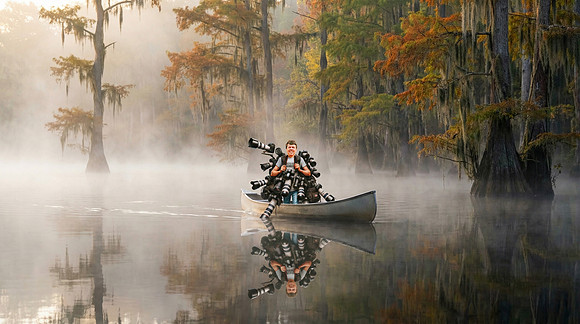
character I call Camera Guy George. He’s intentionally cartoonish, a playful representation of my love for photography. I’ve placed him in only two environments so far, and this is actually the first time I’ve shown him publicly. Maybe I’ll use him again someday, maybe not. But for now, here he is: in a canoe, in a swamp, ready for whatever photo opportunity comes his way.
2. Restoring private, personal images.
The second use is restoring old family photos, damaged, faded, or nearly lost. These images matter only to me and my family, but being able to bring them back to life is deeply meaningful. For that, AI is a gift.
3. Fixing once-in-a-lifetime photos when reality gets in the way.
This one is more controversial. Some might call it “cheating” but hear me out.
Imagine saving up for a major trip to a historic city you may never visit again. You arrive ready to capture legendary landmarks, only to discover that half of them are wrapped in scaffolding. You’re thrilled to be there, but the photos? Not so much.
That’s exactly what happened to me in Istanbul. It’s an extraordinary city, rich in history, alive with culture, and overflowing with moments worth remembering. But two of the buildings I was most excited to photograph, the Hagia Sophia and the Blue Mosque, were undergoing renovations. Several minarets were swallowed in scaffolding, diminishing the beauty I had hoped to capture.
So yes, I used AI to remove the construction and reveal the architecture as it should look, or at least as I hoped to see it. I still have the original, accurate images. My memory is intact. But I also have the pictures I’d dreamed of taking, and that felt like an honest and satisfying enhancement.
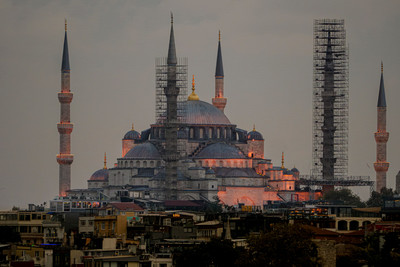 Blue Mosque - BeforeRight out of the camera, no edits.
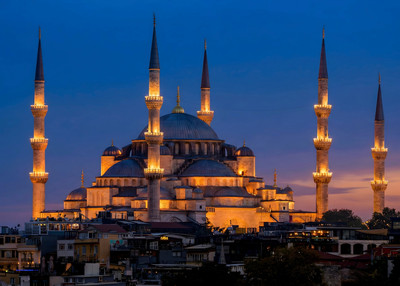 Blue Mosque - After Edited and AI applied to the construction.
Was it cheating? Maybe to some. But out of more than 5,000 photos from that trip, and after culling the majority, I used AI to remove unsightly temporary distractions on only five images. Just five. And each one helps me remember a once-in-a-lifetime journey the way I had hoped to experience it and the way millions of others have.
So that’s where I stand.
How about you?


